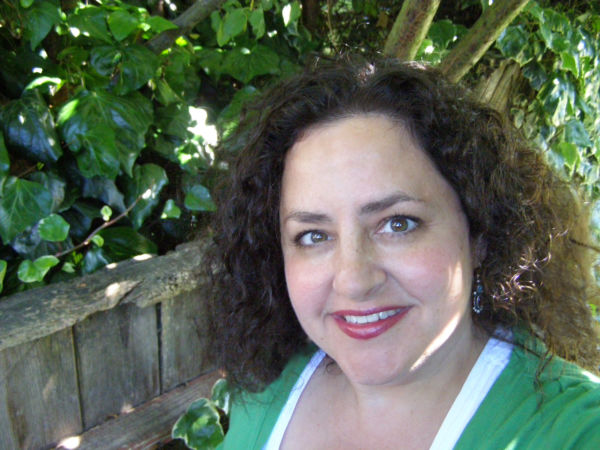
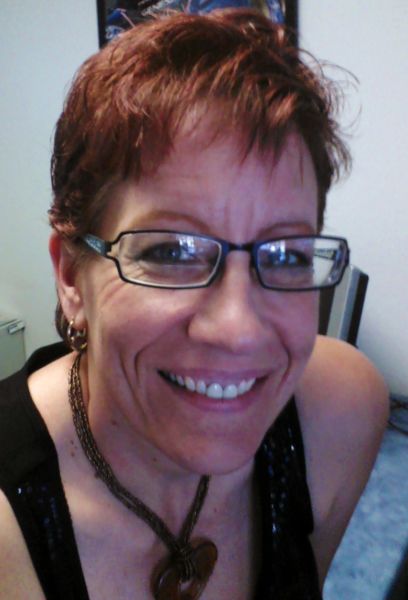
Lynda Bailey lives in Reno, NV with her husband, Pat, her son, Will, two dogs, Cerveza and Athena, and her cat, Groucho. After graduating in 1980 with a bachelor in technical theatre from the University of Northern Iowa in Cedar Falls, IA, Lynda moved to Reno and got a job working on Don Arden’s huge stage show, Hello Hollywood Hello. This is where she met her husband Pat. Their “cute meet” story wasn’t so much cute as it was painful – for Lynda. They were bouldering (a milder form of rock climbing) with some friends near Pyramid Lake when she fell and dislocated her shoulder. Since Pat was so kind and sweet, he offered Lynda a place to stay while her shoulder healed. Twenty-seven years later, she has yet to leave.
Lynda is the current president of The Unnamed Writers’ Group, an all-genre writing group in Northern Nevada. Her Golden Heart® manuscript – WILD FLOWER – was actually written about ten years ago then left to languish under Lynda’s bed. A year ago she blew off the dust mites and revised it into an erotic historical western.
Lynda’s Golden Heart® manuscript is WILD FLOWER, a finalist in the historical romance category:
INDIAN TERRITORY 1882
She made a deathbed promise. Matilda Townsend believed her father’s passing would finally free her from trying – and failing – to please him. Raised more as a ranch hand than a woman, she’s shocked when her dying father asks her for one final promise: to marry the ranch foreman.
He gained an unwilling wife. Logan Cartwright has long admired the beauty Matilda hides beneath her dusty cowboy clothes. But when she bargains to leave him sole owner of the ranch if he’ll grant her the freedom to leave Indian Territory, Logan must admit he’s more interested in keeping his wife than his property.
A contest of wills sparks passion. While Matilda clings to her refusal to share her husband’s bed, Logan coaxes her into exploring the other many and varied ways a man and wife can please each other. Even as their passion blazes hotter than a prairie fire, they much confront a danger that threatens to destroy the ranch and divide them forever.
And now a little more about Lynda…
1) How long have you been writing? I’ve been writing for almost twenty years. During that time, I’ve penned six novels – not including all the rewrites – numerous short stories and a novella or two.
2) Did you always want to be an author or is this something you fell into later in life?
Stories have always rattled around in my head. I would often think the preverbal “What if” about a book, television show or movie. “What if” the hero did this instead of that? “What if” the movie had a sequel? “What if” the two secondary characters hooked up and had a story? The tipping point came when I had a story based on the TV show, Star Trek, Deep Space Nine – cheesy, I know – but it absolutely refused to leave my head. Sooooo, when my husband was out of town on business, and our three-year-old was tucked into bed, I sat down and typed it out. Thus an obsession was born.
3) What do you do in your “other” life? (Day job, family, etc.) My “day” jobs, besides being bottle washer and primary dog walker (my husband’s the chief cook), are working as a fitness instructor and an elementary school substitute teacher. You could say I’m an equal opportunity beater – I mean teacher – of the young and not-so-young.
4) Who are your favorite authors?
My favorite authors include Lorraine Heath, Maggie Osborne and Jodi Thomas – who’s up for a RITA this year!
5) Do you have an agent? At present I don’t have an agent. But I’m working on it!
6) Where do you see yourself in five years?
In five years, I’ll be a lot closer to 60 than I am now! I expect to still married, but without the adult child living at home. LOL! Hopefully I’ll still be kicking butt in my fitness classes, either as instructor or participant, but probably won’t be working as a substitute teacher. Of course, I’ll still be writing. Whether I’ve been blessed enough to get an agent or be published, my stories will insist on being told. To deny them is not an option.
Working Writer
Though I’ve been writing for the better part of two decades, it’s only been in the last six months that I‘ve embraced the title of working fiction writer. I know some believe a “working” writer is a person who gets a paycheck for what he/she writes. In my opinion, that person’s an “author.” For me, a working writer is someone who works everyday to improve his/her craft and who’s striving for publication. I can see the immediate eye rolls with the accompanying, “Well, duh!” However, this was not as easy a journey for me as it might have been for others.
When people ask me what I do for a living, I typically say substitute teacher, fitness instructor, writer. In that order. The writer part almost always gets the biggest reaction.
“Really? You’re a writer? What have you published?”
“Uh, nothing. Yet.”
Chins usually tick up a fraction at this point as eyes narrow slightly. A writer, huh? Yeah, right.
While I strive to improve my writing and move ever so slowly through quicksand that is the publication process, the response I get to claiming to be a writer – and an unpublished writer to boot – makes me wary. Makes me feel I’m being a bit. . . .snobby.
That is until I recently subbed for a favorite teacher of mine, Jolene. Because Jolene knew of my addiction to writing romance (she’d even been a Beta reader for one of my novellas), she wanted me to share my creative writing process with her class. I thought she was nuts. Admit that I wrote books? To twelve-year-olds??? This age group is only slightly less deadly than sharks smelling blood. But I agreed, knowing I had the threat of detention until they all died should any uncontrollable snickering and/or giggling break out. Let me tell you, that sixty minutes was one of the most stirring hours I’d ever spent teaching. The kids sat there, their eyes bright, hanging on almost my every word. It was a very moving moment for me because I was talking about my writing. I wasn’t viewed as pretentious or arrogant. But as a writer. I even choked up once or twice. And tears positively stung my eyes when I stopped by Jolene’s class several months later to tell her about my Golden Heart status. The entire room of sixth graders stood and applauded.
Over time, I have grown accustomed to the title of writer. Yet I never really considered it a “job.” Until now, that is. Though I have yet to land an agent or to be published, thanks to Jolene’s kids, doubt no longer exists that I am a working writer.
What about you? Have you always considered yourself not just a writer, but a “working” one, minus the paycheck? Did you experience a similar “Ah-ha” moment? I’d love to hear about it.
And I keep meaning to post this but have been distracted by all the fab GH spotlights. Anyhoo…here’s the widget for my July 27th release, book 2 in the Eternal Guardians Series – ENTWINED! I’m thinking a contest is in order (I haven’t done one in a while), so if you’d like to win a $25 gift card to the bookstore of your choice, simply past this widget on your blog sidebar, FB page, etc and tell me in the comment section of this post where you posted it. I’ll draw a winner in the next couple weeks.
Heather Snow is a historical romance writer with a degree in Chemistry who found she much preferred creating chemistry on the page, rather than in the lab. She is forever trying to wrangle her left and right brain to work together (some days with more success than others!), but if her two sides had to duke it out, left would win every time—which can be a creative challenge. Luckily, she loves challenges…she just goes about solving them analytically.
In addition to finaling in the Golden Heart, Sweet Enemy won the 2010 Chicago North Fire and Ice in the Historical Category, and is a current finalist in the Kiss of Death’s Daphne du Maurier and Hearts Through History’s Romance Through the Ages contests.
Heather’s Golden Heart finaling manuscript in the regency historical category is SWEET ENEMY:
Beakers and ball gowns don’t mix. So when lady scientist and practically on-the-shelf spinster, Miss Liliana Claremont, receives a coveted invitation to the Earl of Stratford’s house party, no one expects her to accept. After all, it’s well known the newly belted Earl, a war hero and rising political star, is in need of a bride, and it’s assumed he will choose a wife from the select group of attendees.
Yet Liliana has no desire to lure the rich and powerful earl into marriage. She’s come to Somerton Park in the guise of husband-hunter for one reason—to uncover what he knows about the murder of her father. She intends to find justice, even if she has to ruin Stratford to do it.
Liliana believes the best way to get the evidence she needs is to keep her enemy close, though romance is not part of her formula. But every good chemist would do well to remember—if you combine two unknown substances, you just might start a reaction you can’t control.
And now here’s a little about Heather…
1. How long have you been writing?
I’ve made up stories here and there throughout my life, from being a little girl who invented a mermaid kingdom on a rocky beach at the lake during the summers (which, of course, I presided over as princess), to the semi-serious twenty-something who first started a Quantum Leap novel that sadly was finished right after the line closed and then moved to suspenseful serial killer novels that I never finished because they got too dark for me, to the woman who is today actively pursuing a profession as a historical romance novelist. When I decided upon writing as a career, I realized that I wanted to write what I loved most—romance. I immediately joined RWA (in 2007) and jumped into learning the craft. With a detour for a baby (who’d have guessed that creativity required REM sleep?), I have rededicated myself to writing since fall of 2009.
2. Did you always want to be a writer or is it something that developed later in life? Looking back, I can say my right brain always wanted to be a writer, but my left brain steered us towards other things. But when my mind needed a break, a story always seemed to be lurking. In my early 30’s, I faced a cross-roads of what to do with my life and I gave in and let the right brain win for a change.
3. What do you do in your “other life”? I have a fabulous husband and the most incredible little boy. He’s two, which should tell you a lot about how I spend my time! I am fortunate to be able to focus what remains on my writing. Before our son was born, I spent five years facilitating a Christian-based education program inside the federal prison system.
4. Who are your favorite authors?
There are so many, I couldn’t possibly name them and so many that I just haven’t had time to discover yet. However, there are several who write in my genre that I wish I could channel for their sheer brilliance in different aspects of the craft, including Lisa Kleypas, Laura Lee Guhrke, Sabrina Jeffries, Julie Garwood…oh, I could go on forever.
5. Do you have an agent? Not as of yet. I’ve only just begun submitting, but am ever hopeful.
6. Where do you see yourself in 5 years? Hmmm…summer of 2015…I should be Supreme Empress of the mermaid kingdom by then…wait, sorry. J I hope to have another child and to be eagerly awaiting the release of my seventh book, which I will be signing at the Literary Signing at RWA Nationals in New York. See you there!
And now, in Heather’s own words…
Finding the Right Chemistry
“The Chemist who can extract from his heart’s elements compassion, respect, longing, patience, regret, surprise and forgiveness and compound them into one can create that atom which is called Love…” –Kahlil Gibran
Hello. My name is Heather, and I am a left-brainaholic. I’m also a plotter, who must be dragged kicking and screaming into the pantsing that comes between plot points. I have accepted that my process is evolving and I am hoping against hope that one day, I will settle into a comfortable truce between these left and right brains of mine.
When I decided to pursue writing as a career, I tackled it much as I would any other challenge—analytically. I went to the library and checked out one of those “Idiot Guides to Writing Romance”. Oh yes. I did. The biggest take-away from that book was an introduction to Romance Writers of America. Before that, I had no idea such an organization existed. I immediately joined and sought out a local chapter…bar none, the best thing I could have done as a new writer.
Then, I picked my six favorite historical romance novels and read them with analysis in mind. First, I read them straight through, and then wrote out the stories as I saw them in four parts so I could understand how they were constructed. Then I went chapter by chapter to see how pivotal plot and character elements built upon each other. Then I did a character study for each character, including secondary and ancillary ones to analyze why they made it into the book and what purpose they served.
Sound crazy? It does to me a little now, too, but I still refer back to those notes when I’m struggling to keep my stories tight.
However, then I had to learn how to let my right brain have reign. Imagine my surprise and dismay when I realized that emotion and creativity couldn’t be synthesized at my command, and that in order to create a story that grabs the reader, I would have to let the emotional side of myself out into the world…at least on the page. Arrrgh. I still struggle with that.
But then, one day it hit me. My background in chemistry had prepared me for writing romance better than I had thought. There are rules to follow, and some you can break when you want to experiment. Historical romance, like science, requires careful research. Most chemical reactions require a catalyst to drive them, just like our characters and each thing that happens between them require motivation to drive the story forward. Both chemistry and writing, if done well, require a precise mixture of elements and careful manipulation. Many things can go wrong and most times you won’t know what it was until you back track through each step of the process to see where your reaction/story went awry. And just like when you write that scene that just makes you want to sigh, there is poetry in the laboratory when something you’re working on goes just right—a sense of profound satisfaction.
And I think Carl Jung said it best when he said “
The meeting of two personalities is like the contact of two chemical substances: if there is any reaction, both are transformed.”
So even though I didn’t intend for my chemistry background to prepare me to write romance, I am certain that it did. What experiences in your “other” life prepared you for writing? Or if you’re not a writer, have you been able to use past experiences in a way that surprised you?
Elisa Beatty loves moving between contrary worlds: raised on the East Coast in a deeply “historic” Revolutionary-War-era town, she now lives on the West Coast, just north of uber-progressive Berkeley, California. Her parents were scientists, but she fell in love with the arts, especially theater and writing. She went on to do doctoral studies in literature, specializing in Shakespeare and gender studies, but is fascinated by popular fiction—her bookshelves have Dostoevsky, Donne, Woolf and Foucault rubbing shoulders with scads of romances. An English teacher by trade, she spends whatever free time she can grab (including SUMMER!!) writing Regencies.
In addition to being a two-time Golden Heart finalist, she won the Historical category of the 2009 Golden Pen, and so far in 2010 has finaled in the Emily, Great Expectations, and Fab Five, with a double final in the Beau Monde’s Royal Ascot. You can learn more about her her website and at the 2009 Golden Heart finalists’ website, The Ruby Slippered Sisterhood. You can also friend her as Elisa Beatty on Facebook.
Elisa’s 2010 (and 2009) Golden Heart manuscript is A MOST IMPROPER GENTLEMAN, which finaled in the Regency category both years:
Octavia Hathawood’s too smart to fall for her own worst enemy. So why can’t she resist the improper advances of David Castleleigh, Earl of Atherton? The man’s vicious half-sisters drove Octavia’s family from the ton with gossip branding her late father a murderer. Now, with the Hathawoods facing the poorhouse, Octavia returns to London seeking decent marriage, only to find the earl apparently bent on convincing the ton she’s about to become his mistress.
They engage in a battle of razor-sharp wits, and of surprisingly vulnerable hearts—and half the time Octavia’s not sure whether her pulse is hammering out of anger, fear, or anticipation of the next time David’s touch will turn her flesh to flame. Meanwhile, her father’s murderer reappears, and this time he’s got Octavia herself in his sights. Does Octavia dare believe David’s insistence he’s nothing like his sisters, and trust his claims he genuinely longs to cherish and protect her? Or—as she fears—is his seductive charm actually the most dangerous weapon leveled against her?
And now a little about Elisa:
1) How long have you been writing? I was babbling stories as a toddler, so learning to actually write down stories in first grade was the greatest thrill I could imagine—even though I was so physically uncoordinated no one could decode my messy handwriting before junior high. My brain is still constantly concocting stories, and I talk to characters in my head all the time, though I’ve finally learned how to keep my mouth shut when I do it.
2) Did you always want to be an author or is this something you fell into later in life? Well, I ALSO wanted to be a and an astronaut and an actor and (when I reached adulthood) a teacher, which is what I spend most of my professional time actually doing, but I’ve always, always needed to write. Back in college, I submitted a couple stories to The New Yorker, and got what I now recognize as extremely encouraging rejections. But it’s only been the past couple of years that I’ve gotten serious about pursuing publication.
3) What do you do in your “other” life? (Day job, family, etc.) I’m the mother of two amazing kids: a daughter who’s almost twelve, and a son who’s about to turn six. My husband’s also a teacher and writer, and has serious artistic and musical talents too (ironically enough, his parents were science people, like mine), and the artistic streak seems to have been passed to our kids. We live in a creative hive: all of us writing or painting or making music or (in the case of the youngest) building elaborate space stations out of Lego. The dog thinks we’re completely nuts.
4) Who are your favorite authors?
How long a list do you want? There are SO many, and I love them for so many different reasons. Shakespeare, of course, and Iris Murdoch, Nawal el Saadawi, Toni Morrison, J.K. Rowling, Patricia Gaffney, Georgette Heyer, the Brontës, Patrick O’Brien, Dorothy Dunnett, Milton, Virgil, Mary Balogh, Sherry Thomas, Meredith Duran, Tony Kushner, Elizabeth Bishop, Eloisa James, Julia Quinn, and Joanna Bourne. I’ll stop there, or you’ll run out of blog space.
5) Do you have an agent?
Not yet. I’ve decided to finish my second book before I move further on trying to sell my first. The second book, The Devil May Care, has been doing really well in contests this year, and has several agents and editors I’d love to work with waiting on the full. Now that summer’s here, I have ten glorious weeks to be a full-time writer (!!), so I should have Devil finished before Nationals, and the third book underway before school starts in September.
6) Where do you see yourself in five years?
Well, I’ll have a few more finished books under my belt, and my goal is to have at least one three-book deal with a major New York publisher. I have multiple sequels in mind for both Improper Gentleman and Devil, and lots of other ideas clamoring for attention in my head. I’d love to be able to support myself writing, so I can give all these ideas the time and attention they need.
And now, in Elisa’s own words…
The Creative Urge
Awhile ago, a new acquaintance told me, “I’m not a creative person. That’s just not something I have in me.” She shrugged, as if this were a trivial admission, along the lines of saying she didn’t care for asparagus, or had never been to Wisconsin.
I was struck dumb. Not a creative person? It was like she’d said, “I don’t breathe oxygen. That’s just not something I do.”
I assume humans are innately creative. Evolution demands it. How else could small, soft, clawless, fangless creatures survive and thrive? Something inside drives us to make new things where only raw materials existed before—mud huts, bows and arrows, fishing poles, leather shoes, venti non-fat mochas with whip cream and a sprinkle of cinnamon, stuff like that.
We invent, we imagine, we see things anew every day, or….we freeze to death, or get eaten by bears. Or at least get really bad caffeine-deprivation headaches.
Until a generation or two ago, our ancestors did some form of creative work almost every day: farming’s essentially creative, after all, as are weaving and sewing and knitting, and furniture-carving, and barn-building, and making cooking pots out of copper or clay.
Creativity’s in our DNA.
Or maybe not….
I’ve seen counter-evidence before. I’ve heard people say they have boring dreams (what an oxymoron!)—no sound, no texture, just flickers of black and white, replaying their day at the office, with, at most, a talking parrot in place of their boss.
And, in the classroom, lots of my students seem baffled by Aristotle’s definition of mimesis: the deep urge to create artistic “imitations” of our world. Invariably, I explain it by saying, “It’s that pressure you feel inside, when you see something happen, and you just have to, have to, have to write about it, or paint about it, or compose a song about it!” About a third of the kids nod eagerly, like that urge is a daily part of their lives, too. The rest look utterly blank.
Still, I can’t wrap my brain around the idea that some people (most people?) live without that creative urge. What must consciousness feel like for them?
We may live in a world where warmth and safety don’t depend on our creativity, where we get woven blankets and cooking pots with a swipe of the charge card at Target. But some of us still have to make things. Or…our brains will explode.
For me, the creative medium is language. Strand me on a deserted island, and I’ll be fine with eating scorpions and getting soaked by monsoons. But if I don’t get hold of some berry juice and a leaf I can write on, that’s when there’ll be trouble.
It doesn’t matter that every other responsibility in my life is screaming at me for attention. It doesn’t matter if I haven’t had a decent night’s sleep in weeks. It doesn’t matter if I walk around talking to myself like a crazy-old-cat-lady because some characters in my head are deep into dialogue, and that’s all I can hear. It doesn’t matter if no one else ever reads what I write. I have to do it.
And I suspect that’s just how it is for other writers.
On my writing desk, I have a coffee mug with these words from the painter Claude Monet: “Color is my day-long obsession, joy, and torment.”
Obsession, joy, and torment. Yup. That about sums it up for me.
What about you? Do you feel the creative urge? Where do you think it comes from? Does it bring you mostly joy, or mostly torment? Can you imagine your brain without it?
Gabrielle Luthy spent her teen years on a mango plantation in Central Queensland, Australia. While her brother quickly got his driver’s permit so he could go play in the closest big smoke (60,000 people), she was content to stay home and write tales of people playing in other big smokes (San Francisco was a favorite, and remains so). She moved to Melbourne for the career opportunities and the coffee before heading off to Paris (where the coffee sucks). After five years of working for the Organization of Economic Cooperation and Development, she’s back in Melbourne, sharing an apartment with 2 18-year-old cats who don’t realize they’re geriatrics, and planning a move to another big smoke. New York City’s topping her current list, although Montreal holds a certain appeal.
Her writing has won numerous awards, most recently the 2009 Golden Rose and the 2009 Beacon Unpublished with The Lake Effect, which also won the Single Title category and Grand Prize of the 2009 Launching A Star contest. You can read more about Gabrielle and her writing on her website. Here’s a little about her Golden-Heart finaling manuscript in the Novel with Strong Romantic Elements category, THE LAKE EFFECT:
Twenty years ago, wide-eyed Midwesterner Farris Degraw went to summer camp in Maine and came away with five friends who would change the course of her life: Lucy, hiding secrets behind a flamboyant exterior; Tucker, whose quirky outlook gets them through the dark times; self-contained Down-Easter Craig; and Sara, the kind, clever Bostonian Farris wishes she could be. And then there’s Dan. The child of career diplomats, Dan Owens learned to be different things to different people, without learning to be himself. For years, Farris followed him around the country—until she asked him to follow her and he said no.
Now, with Sara terminally ill, the friends gather at a lake in Maine for one last Christmas. A successful designer who’s come a long way from star-struck teen, Farris is determined not to fall under the spell of the man she left seven years ago. But it turns out that—like old insecurities—first loves aren’t easily vanquished, and Dan isn’t quite the bad guy Farris remembers. Things are busting wide open at the lake house, with all six forced to confront the complexities of friendship, betrayal and the enduring links between past and present. In doing so, Farris must learn to let go of past disappointments and rediscover what matters most: love.
And here’s a little bit about Gabrielle…
1. How long have you been writing? Since I was thirteen. I was reading Book 3 of a beloved series and couldn’t believe the author killed off my favorite character. So I rewrote the book, saved the character, and found my calling in the process. (See? There is a place for righteous indignation in this world!)
2. Did you always want to be a writer or is this something you fell into later in life? Apart from a few short months when I was about six and thought I might try becoming a ballerina, I can’t remember wanting to be anything else. Once the writing bug bit, nothing else mattered. I remember being in a chemistry exam and shocking the teacher by asking for more paper. He thought I’d given up on that class, and he was right: I’d circled A, B, C, D for the multiple choice questions then used the essay time to work on whichever angst-ridden YA I was obsessed with at the time. Years later, I stood in front of the how-to-write section of a Barnes & Noble in New Haven, CT, and thought, “Well, someone’s making a living from this, why not you?” That’s what I’ve been working on ever since, and every job I’ve ever had was to keep the cats in kibble until that happens.
3. What do you do in your “other life”?
Try to escape it <g> Actually, I work in IT with some really cool people. And I watch people. I live in a bayside suburb known for its hijinks, so I’m guaranteed writing fodder every time I step out of my apartment. (Actually, I can stay home for that. The lane beside my bedroom is often the setting for late-night drama, and I’m still trying to figure out what my upstairs neighbor does for a living.) When I’m not watching people, I’m watching copious amounts of TV. I write visually, with everything playing out in front of me, and some of my best writing lessons have been from shows such as E.R., Friday Night Lights, Californication, Breaking Bad, Being Erica, The West Wing, United States of Tara and Rescue Me. (Great excuse, huh?) When not doing that, I’m making scented candles and taste-testing my latest attempt at creating the perfect margarita.
4. Who are your favorite authors? Yay! My favorite subject! My auto-buys are Emily Giffin, Julie Buxbaum, Megan Crane, Jonathan Tropper, Sarah Addison Allen, Armistead Maupin, Barbara Samuel, mystery writer Earl Emerson, and Caleb Carr—whether he’s writing historical fiction, historical non-fiction or cranky letters to the editor, I’m there. I get a physical buzz from writers who twist the English language into something bold and rambunctious: Hunter S. Thompson, Denis Leary, Diablo Cody, David Foster Wallace, and San Francisco Chronicle columnist Mark Morford, whose collection, The Daring Spectacle, I’m giggling my way through. I also read a lot of YA (I just finished and adored Keris Stainton’s Della Says: OMG!) and non-fiction, mainly pop culture and current affairs. My most treasured book is Robert Redford’s The Outlaw Trail, a photojournalistic account of the horseback trip Redford and a National Geographic team took in 1975, from the Canadian border all the way down to Mexico, as they traced the path the outlaws rode and chronicled a way of life that’s since disappeared.
5. Do you have an agent? Not yet, but all offers will be entertained
6. Where do you see yourself in five years?
Weird thing: a few months ago, I had this image of me living in an apartment just like Josh’s from The West Wing. I don’t know where exactly, just that it was East Coast (maybe Brooklyn, maybe D.C.) and I was watching snow fall outside. So, as freaky-deaky as it sounds, I’ll say I’m going to be living in that apartment, with several of my books on the shelves, working like crazy to complete the others I’m contracted for and continuing my hunt for the perfect margarita during my down time. Yeah. That sounds just about right.
And now, in Gabrielle’s own words…
Setting: much, much more than just a place
A few days before NaNo 2008, when I was committed to the task but with no idea what I’d write, my first question was, “Where is this set?” The answer came back to me almost instantly: in Maine, on a lake with a winter storm closing in. Never mind that the most time I’d spent in Maine was a day trip to L. L. Bean, or that I had no idea which lake, or what it was like to live through an ice storm. Because, while many writers start their manuscripts with a character or a situation, more often than not, I start with setting—and once it’s determined, I can’t change it without changing the whole book. Let the research begin!
It’s fair to say I’m obsessed with setting. It dictates the characters, the season, sometimes even the events. It also dictates my reading. Contrary to what I once heard an editor say, some readers do buy based on setting. It might not be a deal-breaker/clencher, but I’m very happy that Amazon allows me to search by whichever setting I’m in the mood to read; I’ve found a lot of favorite writers that way, most recently Julie Buxbaum, whose NYC-set book The Opposite of Love I might have missed. And that, my friends, would have been a travesty.
I’ll admit it: screwing up setting can prejudice me against a writer. I stopped reading a massive bestseller after only a few pages because the character drove from Paris’s Ritz Hotel to the Louvre via the Opera Garnier—something you just wouldn’t do when you’re supposed to be rushing to a murder scene. Extreme, perhaps, but I didn’t feel I could trust the writer because his characters were out of synch with his setting. I knew I was going to have a hard time with a former critique partner when she set a manuscript in NYC, left out any mention of setting apart from a trip to Central Park, and told me it was an editor’s job to include the detail.
Have I screwed up setting? Oh yeah. I once wrote a scene where a character drives down a Paris street, then later walked it myself—and found huge bollards that prohibited driving. I was lucky that I had the opportunity to check out my setting in person. I’m sure that wasn’t the only mistake I’ve ever made, but not for lack of trying. In the days before Mapquest then Google Earth made things easier, I’d pour over maps, vacation guides and Yellow Pages, to get an idea of layout, topography, local businesses—anything that would help me walk the streets just like my characters. Historical writers, you have my admiration for bringing to life places that may have changed drastically—or may no longer exist. Futuristic and fantasy writers? You make me feel lazy!
Setting also influences character and creates conflict. Although The Lake Effect takes place in Maine, the character of Dan is rooted in the kids of the friends I made while living in Paris—smart, sophisticated Anglophone teens straddling two cultures and not always sure how they fit into either. There’s a big difference between a kid from that world and one raised, as The Lake Effect’s lead character Farris was, in a small Midwestern town. No matter how much she wants out of that town, there will be things she won’t understand in the world she chooses, which leads to conflict. And while I do my best to avoid character clichés, there are some details that just make sense. For instance, in Learning How To Stay, set in L.A.’s Topanga Canyon in summer, my characters drink margaritas creek-side and chow down on Double-Doubles from In-N-Out Burger, while in The Lake Effect, the characters crave Fribbles from Friendly’s. (Did I mention that I love to vicariously eat and drink via my characters? Coz I do, almost as much as I love vicariously living in their fabulous houses!)
An unexpected, happy consequence to being setting-obsessed is the people I’ve met, both online and in-person, in my quest for detail. I’ve found that the majority of people enjoy helping writers—even if they can be a little suspicious at first. I once had a lady in San Francisco ask me if I was carrying a gun before she invited me into her house to check out the period features and design. I’ve also struck up an online friendship with the person who lives in the house I’m using in an upcoming manuscript. I knew the house’s address, found photos on Flickr and mailed the poster, asking for information on the logistics associated with living in a hillside house accessible only by stairs. She answered all my questions and more. It works the other way, too: when my friend was writing a book set in my ‘hood of Montmartre, I was able to help her out with the apartment building she’d chosen for her protagonist—because, out of all the buildings in Paris, it just so happened that my landlady lived there.
How about you–does setting play a major part for you, or is it a bit character? Are there particular places you keep coming back to in setting your books, or do you prefer to revisit the same one and introduce new characters to it? What tips can you share on researching your setting?
Lizbeth Selvig is living her dream life in Webster, Minnesota (40 miles Southwest of Minneapolis) with her husband of 35 years, a hyperactive Border Collie, a huge yard but no riding lawn mower, and her very own office now that her children are grown and the bedrooms cleared of My Little Ponies and Magic The Gathering posters.
She doesn’t have to work outside the home at this point in her life but, somehow, she’s never bored and rarely spends a full day at home. A paying job, which would provide welcome discretionary cash for conferences and travel, would definitely take away from her free time (no sympathy expected).
Over the years, Liz has been able to travel with her family thanks to her husband’s job. His work as a computer systems analyst for Lockheed Martin has taken her to Germany two different times, for a year each time, to Toronto, Canada for a year, and to Anchorage, Alaska for three years. Each place is dear to her, especially Alaska, where she left a big chunk of her heart at the end of 2008. Now she loves to include experiences from these travels in her contemporary novels. She’s currently working on a three-book series set in various parts of Alaska.
Lizbeth’s manuscript SONGBIRD, finaled in the Golden Heart® Single Title Contemporary category:
There comes a time in every independent woman’s life when she just has to step aside and let a White Knight do his job.
Abby Stadtler might need a white knight, but she doesn’t want one, especially not a rock singer who’s missing a son and has paparazzi hot on his trail. Gray Covey might be a superstar to the world, but in reality, he’s a frantic father searching for his son.
When Gray’s search lands him at a deteriorating horse farm, where his boy has befriended Abby’s daughter, he enters chaos personified. He discovers one teen who hates him, one teen who adores him and a woman who flips his heart on its axis.
And now, here’s a little bit about Lizbeth…
1. How long have you been writing? I’ve been making up stories ever since I was old enough to embellish on movies I went to see as a kid. My mother’s voice is clear in my memory: “Lizbeth Claire you don’t have to tell us every word and then some.” But I was positive the way I was telling the story and reciting the dialogue was far more fascinating than sitting in a dark theater watching it all happen. As far back as age five, I remember putting myself to sleep by creating stories in my head. By age eleven I was filling notebook paper with stories and writing myself to sleep rather than reading. There was also this round robin novel in junior high school that got quite long. (Some things never change.) All I remember of it now was that it starred a horse and a handsome, teenaged hero named Lincoln.
2. Did you always want to be an author, or is this something you fell into later in life? I always knew I wanted to write. The thought of seeing my name on a book or being famous for writing a novel didn’t occur to me until late in high school. I wrote for my school newspaper and covered high school sports and school board meetings for our regional, weekly “Dakota County Tribune,” and that kind of gave me a taste for bylines. I went on to college and earned a journalism degree. It would have been nicer to get a fiction-writing degree, but the University of Minnesota didn’t offer that yet — back when we were still carving on stone tablets and our Internet consisted of a bunch of guys standing on the various dormitory roofs around campus sending smoke signals.
I worked for several weekly newspapers after graduation and wrote short stories of the Good Housekeeping, McCalls and Redbook variety. I submitted a few and got my first “great rejection”: a handwritten note that read, “Nice writing. Sorry.” After that, I knew I wanted my name on a short story, in a big magazine. I got married, had two children and kept writing—but I truly treated it as a hobby; something that was just an escape, even though I read Writer’s Digest and pored over Writer’s Market endlessly, starting to dream about actually writing a book. My first novel was a work in progress for fifteen years. I worked as a magazine editor (sadly, not for Good Housekeeping, but for two different farm publications—hilarious for a city girl). After a lifetime of loving to write stories, it’s embarrassing to say I didn’t take my fiction writing seriously until my kids were grown. Now, it’s the “job” I love!
3. What do you do in your “other” life? (Day job, family, etc.) I’m the luckiest “kept” woman in the world at the moment. By that I mean no disrespect to myself, but mean it as a huge thank you to the most supportive hubby in the world. He’s been willing to sacrifice (i.e., go to work and mow the lawn and cook most of the time) so that I can live the dream life of a full-time writer. I’m not sure he isn’t expecting to retire on my Nora Roberts-like income after the first book sale, but I love him too much to smash the illusion yet. At any rate, I’m finally getting to write and I’m trying to make the most of that blessing.
In my non-writing life, I’m Mom to two grown children. My daughter is an equine vet and my son is a musician and production/recording engineer. I volunteer for a youth equestrian organization called United States Pony Club. I love to quilt and I love to scrapbook. We have a crazy Border Collie named Magic, and my husband, Jan, and I are avid hikers and love to camp.
4. Who are your favorite authors? My favorite authors run the genre-gamut from science fiction to mainstream to romance. I have to be a little cliché and claim LaVyrle Spencer as my first “mentor.” I fell in love with her books as so many other readers and writers did. I still wish we had room and time in our busy reading lives for the slow, lyrical writing of that old style-romance. These days I read anything by Susan Elizabeth Phillips, Susan Anderson, Susan Mallery and a former MFW chapter mate, Susan K. Law. I’m also really looking forward to the debut release, “Money Honey” (a shameless plug) by Susan Sey – another Minnesota author. Now ask me why I haven’t donned a pen name starting with Susan. I don’t know. But I believe it’s a requirement of some sort.
I also love the old Robert Heinlein and Ursula K. LeGuin sci fi books. I’m starting to get into Lois McMaster Bujold. I also really liked the first three books by author Sara Gruen. Riding Lessons and Flying Changes are great for horse lovers. Her third, Water for Elephants is what I claim as my current Favorite Book.
5. Do you have an agent? I had an agent for one year, in 2006. She marketed my first book and had no takers. We parted amicably and I’ve been slowly learning the ropes again. (Can also be read ‘gaining confidence back.) I’m actively querying since finaling in the Golden Heart®, and I’m hoping, hoping, hoping my fellow GHers’ Golden Magic pixie dust floats its way to my Dream Agent’s desk and makes her sneeze in astonishment while she’s reading my book.
6. Where do you see yourself in five years? Making long-term goals is a talent I’ve had to learn. I made my first Five-year Goal List this past January during an online class. It was a wonderful exercise, actually quite uplifting. My list reads: In five years I will be: 1) awaiting my third single title release and first fantasy/sci fi release; 2) working actively with my agent to plan the future; 3) writing every day, finishing one romance and one fantasy OR inspirational a year; 4) putting out a quarterly newsletter; 5) still working out and running 5 & 8Ks even though I’ll be, as Wendy Darling says, “ever so much more than twenty.”
And now, in Lizbeth’s own words…
SEDUCED BY TECHNOLOGY
Until the advent of e-mail, I was always certain my epitaph would read:
Lizbeth Selvig Beloved wife and mother. Crushed to death by an avalanche of paper.
For those too young to remember, everyone’s life used to be filled with paper. In the olden days, there was no such thing as an electronic submission. There were no computer files in which to store successive drafts of your novel. If you wanted to find an old friend, or learn that your writing buddy got thirteen pages written, you had to (gulp) pick up the phone or hand write a letter. On paper.
I used to think that if only I could get rid of the stacks of papers and notebooks and letters, my life would run like a Lamborghini. Oh, Deception, thy name is Technology.
Today, I don’t have to do research at the local library and make expensive copies of the information I need. I don’t need to retype a manuscript page because I spelled Mississsippi (with three s’s, did you notice?). I’m pretty sure there are no carbon paper factories anymore. I can Tweet; I can Instant Message. So what color is my Lamborghini, you ask?
Hah. Some days, despite the fact that many fewer trees are giving up their lives for my work, I feel like I’m stuck in a boring brown Edsel with sand in its gas tank.
E-mail? It may be fast, but when I was writing “real” letters, I never had twenty people at one time to respond to, and they never answered my answers in thirty seconds so I had to re-answer. (Or is that re-tweet? I’m easily confused.) Facebook? I was lucky if I knew what my friends were doing once a month. Yahoo! was something the guy on the Mountain Dew bottle hollered—it didn’t have anything to do with loops and messages and threads of discussion.
Don’t misunderstand. I can’t imagine trying to run this writing business without making writing friends in other states or without the encouragement from my colleagues on the loops I’ve joined. I’m so hooked on technology, that I spend the vast majority of my time using it. Far more time than I used to spend sorting my avalanche of papers.
Do you see the circle I’m drawing here? I haven’t learned to control my stacks of electronic paper any better than I controlled the physical ones. We’re counseled to put our butts in our chairs and write, because published books are granted to those who persevere. We are not told that she or he who dies after having written the most e-mail responses wins.
But, how to control the problem? I’m addicted to the sense of connection Facebook and e-mail gives me with my writing friends. I love meeting new writers, and learning from them, and imagining that they care what I have to say. It’s thrilling that an online class with the power to further my career is just a PayPal transaction away. Isn’t this volume of knowledge and community the best thing I can do for my writing? I feel so rejuvenated. Or. I do once I finally get my butt into that chair.
The truth is, playing with technology is oftentimes more fun—certainly easier—than writing. I know the rule-of-thumb is that you should spend no more than 30 percent of your time on “marketing” (i.e., all the technology I’ve been describing). I know in reality nobody waits on tenterhooks for my daily posts. I know my writing suffers when I “just have to get caught up on the correspondence first.” You know what? Sometimes, I miss all the paper. It was much easier to ignore.
And I fear I really have to learn to handle all this new “paperless paper work,” otherwise my epitaph will simply morph into something like this:
Lizbeth Selvig Beloved Wife and Mother Deleted from this life by rogue electrons
So, what advice do you have for those of us who’ve been seduced by technology? What tricks, what discipline helps you keep your bum in the chair writing, not wasting time? Or…IS e-mailing, social networking and researching on the Internet a waste of time? How do you handle the online part of your job?
Happy writing, editing, submitting and celebrating to all my fellow GHers. Can’t wait to meet you face to face in Orlando.
Today I’m thrilled to introduce you to my fellow Rose City Romance Writer, Mary Oldham. I always knew Mary was special, but after reading her bio, now I know why. She’s a Beaver!!!
(Ahem…for those of you who didn’t go to school in Oregon…Oregon State University = the Beavers. I’ll shut up now and let Mary have the floor…)
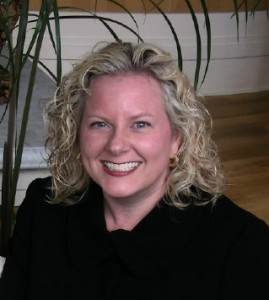
A fourth generation Oregonian, Mary grew up in Eugene, but has made her home in Portland for the last nineteen years. In 1991, she earned a Bachelor of Science from Oregon State University, majoring in Business with a Marketing Concentration and has a minor in Fashion, Apparel and Merchandising.
From the early age of five, she remembers making up very elaborate stories in her head. It wasn’t until she was a bit older that she realized they might actually have validity! She likes to write stories about women she can relate to, smart, business savvy heroines who find themselves torn between traditional roles and their own wishes and desires.
Since she began writing again in January 2008, she’s finaled in eight contests and won two of them. She’s completed five manuscripts, four of which are a series about a hotel baron and his family. Currently, she’s reworking a suspense romance entitled The Voice of Reason.
Mary’s recent contest wins & finals include:
1st Place, 2010 Utah RWA Great Beginnings Contest, Mystery Suspense Category - The Voice of Reason 1st Place, 2009 San Diego RWA, Spring Into Romance Contest, Contemporary Series - The Hotel Baron’s Mistress
Mary’s 2010 Golden Heart manuscript is Laura Takes a Lover, which finaled in Contemporary Series Romance
After failed fertility treatments lead to a bitter divorce, high school math teacher Laura Daniels escapes to her best friend’s beachside estate, Tranquility, to heal her wounds. To her surprise she finds a kindred spirit in the other summer guest, gorgeous widower Adam Black.
Their shared loss quickly leads to undeniable passion. But after three months of stolen moments and awakening sensuality, Adam leaves, abruptly ending the affair. Heartbroken, Laura returns to teaching and discovers she is pregnant. Desperately in love with Adam, Laura vows to find him and tell him about his child. Only one little problem stands in her way; she doesn’t know where to look. In her quest to find Adam, she discovers he is an international hotelier who travels the world. Meanwhile, Laura’s ex-husband will stop at nothing to win her heart and claim the child as his own.
And now, a little bit about Mary…
1. How long have you been writing?
I started writing in the winter of 2000, but after some initial agent rejection, I put the manuscript on the shelf and abandoned the idea that I could write. Then in January of 2008, I was a year away from my fortieth birthday and thought, “Are you just going to sit there or are you going to get back to it?” I wrote nine short stories over the next two months and have been converting them into manuscripts. I now have five of the nine completed.
2. Did you always want to be a writer or is this something you fell into later in life?
It started when a friend suggested I “journal” my feelings about my very short, very bad marriage. A funny thing happened, I ended up writing a manuscript about a woman who kills her abusive ex-husband, gets away with it, and goes on to find true love. Little did I know that I’d written the first draft of my manuscript, The Voice of Reason or that I’d uncovered a passion I didn’t know I had!
3. What do you do in your “other life”?
My career has always been in marketing and media. For the last ten years, I’ve been a major accounts media consultant for The Oregonian newspaper, which means I sell advertising for print, online and niche. I think the sales persona I’ve honed over the years has thickened my skin for the ups and downs of writing!
When my clients find out what I do in my “writing life”, you can watch their expressions change. Sometimes they avoid eye contact or they ask to read something! It’s a lot of fun!
I’m very close to my family, who live in Eugene. I spend a lot of time with them at the Oregon Coast where we have a place in Yachats. The beach is very inspirational for me.
I love to travel and have been fortunate to see a lot of beautiful places. When I started thinking about how I wanted my website to look, I kept thinking about this Villa located on Lake Como in Italy that was one of the most romantic places I’d ever been. Little did I know that the afternoon I spent at Villa Balbianello would one day be the inspiration for my website. Come for a visit!
4. Who are your favorite authors? I have to say Linda Howard inspired me more than any other author. She taught me that authors could be naughty and nice! When I met her last year in Washington DC, I was totally starstruck and could barely speak. When I found out my manuscript, The Hotel Baron’s Mistress, finaled in the 2009 Linda Howard Award of Excellence, I cried.
5. Do you have an agent?
Not yet, but I’m seeking representation.
6. Where do you see yourself in five years?
Hopefully published and happy with the work I’m producing. I wouldn’t mind having my own happy ending with a real hero!
And now, in Mary’s words…
The Sweet Seduction of Writing
People ask, “Where do you get the ideas?”
“My characters speak to me,” I say with a straight face. “It’s magic.”
But finding the magic is an altogether different thing…
I start with a single idea and a blank page. I turn on Diana Krall or a little Chris Botti. The idea becomes a scene in my mind. I dress my hero and heroine, these unknown mannequins and wait for more to come. They take on personalities, likes and dislikes. They tell me their motives and hide a few plot bending whoppers for later discovery. Soon, they confide their fears, desires and the past traumas they’ve survived. The more arrogant of heroes might even criticize the name I’ve given him!
I write a chunk of their story, wondering how it will end. I write a few sweet scenes that fill my precious weekend, only to highlight and delete the hours upon hours of work late on Sunday night. I pump up the music, a little U2 or Lady Gaga perhaps to cleanse my cerebral palette. This continues for weeks, until I fantasize about burning the story in my fireplace.
I love the story.
I hate the story.
It’s the best thing I’ve ever written.
My own mother wouldn’t like it.
It embarrasses even me.
I take a break for a few days. I see my friends and go out to dinner. We go to a movie and I criticize the weak, insipid plot on the drive home, jealous that some author sold their manuscript and they made a movie out of it.
I visit my family at the beach, but the laptop is in the trunk of my car and something about the ocean waves crashing on the rocks fuels my desire to write again.
Back at my day job, one of my coworkers says something that I could use in a future novel…so I write it in the little black book I always carry in my purse. “Did you hear about my new client, his name is Richard Schnipper…goes by Dick…”
I drive to a sales call and my characters start speaking to me again. I tell them to be quiet because I must work the day job for another few hours. I focus on readership, modular ad sizes and deadlines. That night, when I get home, my hero and heroine give me the silent treatment. I retaliate by watching The Bachelorette on television.
Later, dejected, I go to bed with a new Architectural Digest and I see my hero’s bachelor pad on page seventeen. Over the next few hours, the hero and heroine keep waking me with ideas as to the scenes that could unfold in his chic little den of seduction.
I get in the shower the next morning, a scene writing in my pounding head and my smug, silver tongued hero whispers in my ear, “I wouldn’t have seduced the heroine after I’d taken a jog, I’d have showered first…”
Shea Berkley has seduced men, fought vampires, boxed Irish mobsters, invaded siren waters, ran a covert military mission in the jungles of South America, killed evil thingies that go bump in the night and far more on her journey as a storyteller. The world of make-believe is her preferred hang out, but when she’s forced to associate with reality, she has been known to speak to writers’ groups and mentor those interested in honing their writing craft. As a reward for her hours and hours of fun, she has finaled multiple times in several writing contests including 3 times in RWA’s prestigious Golden Heart contest. She writes primarily general fiction and young adult fiction as her large and noisy family runs wild, terrorizing the neighbors.
Shea isn’t much of a contest junkie, but she has finaled in the Golden Heart® contest three times: Irish Dream (2006 Single Title); Dark Secrets (2009 Mainstream with Romantic Elements); Shattered (2010 Young Adult).
Being woefully incompetent in the technology arena (I’m terrified of On Demand TV and TiVo … okay, I don’t even know what TiVo is or if I’m spelling it correctly), Shea only has a personal email account and group blog. She’s been harassed by others to do a personal blog and website, but she finds her brain begins to wander every time someone mentions the challenge. You can find her most days trolling The Ruby Slippered Sisterhood with her lovely and talented “sisters” and usually getting in the way of progress.
And now a little about Shea’s Golden Heart Finaling manuscript…
According to Shea, “Although I love to write for adults, I have a house full of teenage girls, so it was a natural step for me to write YA. I love the stories because they’re so broad, and even though the readers are pushing toward adulthood, they still have that edge of childish fun and awe that can be tapped into when writing for them. My Golden Heart finaling book is called SHATTERED and it’s told primarily from the young hero’s POV. I love writing stories that feel real to life, and then twist them into a fantastical journey, and that’s exactly what I do with Dylan, my young hero.”
At seventeen, Dylan is the son of a teenage runaway who acts as if he’s more of a bother than a blessing. Something buried deep in his childhood scared his mother so much that it changed her view of him. It was the beginning of his fall from grace and a journey into a life that no one in their wildest dreams could have imagined, because who in their right mind would believe he was a creature from another realm? With a newfound power that defies logic, Dylan is more than just different, he’s dangerous, and now he has to make a choice. Save his own skin (something he’s used to doing) or save a beautiful girl (the only person who’s ever made him feel loved), knowing he’ll most likely die while trying.
I asked Shea to answer a few questions so we could all get to know her better. Here are her answers:
1) How long have you been writing? I’m fairly confident I knew how to write when I was five, but I could be kidding myself. The ABC’s did not come naturally to me. Being dyslexic I struggled to get the gist of why reading and writing were supposed to be so amazing. Seriously, it just looked like a bunch of letters strung randomly together for so long, I fought the process of writing even after I finally figured out how to read.
2) Did you always want to be an author or is this something you fell into later in life? Fell is a fairly good description of how I became a writer, though I guess caving to peer pressure would be more accurate. Let me explain.
I grew up in Fargo, North Dakota.
What can a gal say about Fargo? It’s flat, cold, windy and has loads of cows and other farm animals and acres and acres of wheat. But let me tell you, it’s a place that encourages imagination. (#1 activity when I was young? Cloud gazing. I’m pretty sure I was my mom’s version of a tornado warning system.)
I had a best friend named Constance. She was weird, and not because she lived on a goat and chicken ranch, but because she liked to read and write stories. I was nine, and not good at reading or writing, but Connie pushed me. We would hunker down for hours and hours making up stories and run wild playacting. It was my first taste of creating something more permanent than what I imagined in my head. I wish I could say I couldn’t wait for our writing sessions, but reading and writing was such a struggle … Dyslexia is quite the bear to wrestle.
And then at sixteen, my mom tossed a book at me. (Never fear, I played dodge ball and it didn’t hit me … hard.) The paperback was Shanna by Kathleen Woodiwiss. Let me tell you, that book changed my life. I loved it – the heroine was spunky, the hero was poetic – and I consumed every romance I could find, and then branched out into other genres. When I finally got to college, I had conquered the bulk of my dyslexia. There were, and still are, a few areas that give me grief … but a major boost to my self-esteem came from my English professor who told me I had talent and pushed me to write more. I didn’t. Instead, I got married and started a family.
Being a mom of five is like volunteering to be hog-tied and burned at the stake … for fun. (Why don’t more people eat their young?) Luckily (for my kids) I didn’t turn cannibalistic and discovered how writing could be cathartic, just like my English professor said it would be.
So, did I want to be a writer? Yes and no. I fought it from the day I met Connie, and only when it became apparent putting words on paper would counteract my plunge toward the kind of insanity only childbearing brings did I find how much I really loved the process.
3) What do you do in your “other” life? (Day job, family, etc.) Seriously? I have five kids. My job is to make sure they don’t harass the neighbors, and then play dumb when the cops come knocking on my door.
I also teach online writing classes. It pays worse than indentured slavery for the time I put into the lessons and writing exercises, but I love the craft and want to help others love it too.
4) Who are your favorite authors? This is really, really difficult. I read a lot and in a multitude of genres. My favorite authors change as soon as I pick up a new book. Does that make me fickle? I’d like to think it makes me well-rounded story wise.
5) Do you have an agent? I do have an agent. The lovely and energetic Laurie McLean of Larsen and Pomada Literary Agency. She’s knowledgeable, and fierce and in my corner, in other words, she’s everything an agent should be.
6) Where do you see yourself in five years?
You know, this question always baffles me. I’m not one to look too deeply into the future. I live for the present as much as possible because I’m not guaranteed tomorrow, and frankly it’s hard enough getting today right.
But if you’re going to be persistent with this question …
I’d like to be multi-published with a rabid fan base that makes me blush all the way to the bank.
(grin) I am an optimist if anything. But then again, in five years I might go insane and think I’m at the Disneyworld riding rollercoasters and eating calorie-laden food when in actuality I’m sitting in a car sipping a chocolate, nutritional supplement and trying not to drool on myself. Honestly, just so long my kids aren’t allowed to experiment on me, I’ll be content.
(Disclaimer: all references implying my children are the spawn of Satan or have criminal intentions or are evil in any way other than that cute impish way all children act when being darn adorable are just the figment of this author’s imagination. Really. Well …)
And now, in Shea’s own words…
How personal do you want to get?
It’s a question every writer has to ask him/herself. The one thing I’ve learned about writing lately is that writing is personal. It has to be.
When we write, it has to make us catch our breaths. It must reveal something of the human condition that might make us uncomfortable or proud or elicit some kind of response. It has to stir emotion, whether it brings out a soul cleansing laugh or a body-shaking sob. To bring out those emotions for our readers, we have to take risks. We have to dig deep and live the moment with our characters.
So, how can we get in touch with our characters? Although the world sees us as authors, we’re actually more like actors. We have to put on the skin of our characters and write from their personal point of view – how they see the world or to be more exact, revealing their opinion about the world. Every character will have an world POV from the main characters to the walk-ons and as writers we’ve got to show that by the way each of them interacts with others.
So, if you’ve got a guy who has become disillusioned by life, he’ll sport a cranky outlook. His demeanor will be steeped in woe-is-me until someone rescues his attitude and shows him a bigger, better purpose. Think of Luke Skywalker. His character is petulant and he finds no worth in his current life. Not until everything is taken from him does he see how wonderful he had it, and then he’s pulled, kicking and screaming into a purpose far greater than he ever imagined. By the end, he knows he’s doing exactly what he’s supposed to be doing even if there are risks and real life-threatening dangers all around.
In fact, that same scenario can be attached to Scarlett O’Hara. She is so consumed with her petty wants, that when everything is taken from her, she is thrown into disarray. She fights the system of war, grasping at the edges of the life she once knew, keeping things together by bent of will. It’s the way Margaret Mitchell brings out the passion of emotion in Gone with the Wind that keeps us reading about a spoilt, unlikeable woman who deserves what’s coming to her.
Let me give you the best piece of advice I can. “Lack of emotion is deadly. It’ll kill every scene.” I’m not sure who said that, but whoever said it was brilliant.
They say finding the emotion and putting it on the page is the last thing most writers learn to do before they’re published. Do you agree that emotion is important? How do you bring out emotion on a page?
I’ve been sitting on this news for a while now and it’s been KILLING me! Anyone who knows me knows I hate not being able to share good news, especially when it happens to someone I love.
My critique partner
JOAN SWAN
sold to Kensington Brava!!!!!!!!!!!!!!!!!!!!!!
I am published because of Joan, so I knew it was only a matter of time until she sold as well. And I am so so SO excited for her, I can’t even put my enthusiasm into words. Her book – a romantic suspense with paranormal elements – will knock your socks off. It’s so good. Smart, sassy, fresh, fast paced and SEXY. (Scorchingly sexy.) The first time I read it I knew she had a winner on her hands. And I’m THRILLED you all are going to get a chance to read it soon as well.
And the really cool part? Joan sold to my editor at Kensington, so we’re writing for the same house! How cool is that!?
So now that TEMPTED – book 3 in the Eternal Guardians series – is done and turned in, I feel like I can breathe a little and get back to a semi-normal blogging schedule (not that I ever follow a schedule, but you know what I mean). I really REALLY love where TEMPTED ended up. It builds on things that happen in ENTWINED (July 27th, 2010) and is going to be a great lead in to book 4 (which, right now I’m calling UNLEASHED, but when I have an official title, I’ll let you know). Anyway, I’m pretty sure I can share this with you (if not, oh well!), so here’s the cover copy for TEMPTED for those of you who are curious:
DEMETRIUS—He’s the hulking, brooding warrior his fellow Guardians avoid. Too dark. Too damaged. And given his heritage, he knows it’s best to keep everyone at arm’s length.
Isadora is missing. The words pounded through his head like a frantic drumbeat. For her own protection, Demetrius had done all he could to avoid the fragile princess, his soul mate. And now she was gone—kidnapped. To get her back, he’ll have to go to the black place in his soul he’s always shunned. As daemons ravage the human realm and his loyalty to the Guardians is put to the ultimate test, Demetrius realizes that Isadora is stronger than anyone thought. And finally letting her into his heart may be the only way to save them both.
I’ve seen the rough cover art for TEMPTED and I can assure you, it’s awesome. As soon as I can share the real deal, I’ll let you know.
To sign up for Elisabeth's Newsletter, fill in the information below and hit submit. You will receive an email to confirm your subscription.
(Required fields are red)